How to Organise Family Finances After Having a Baby
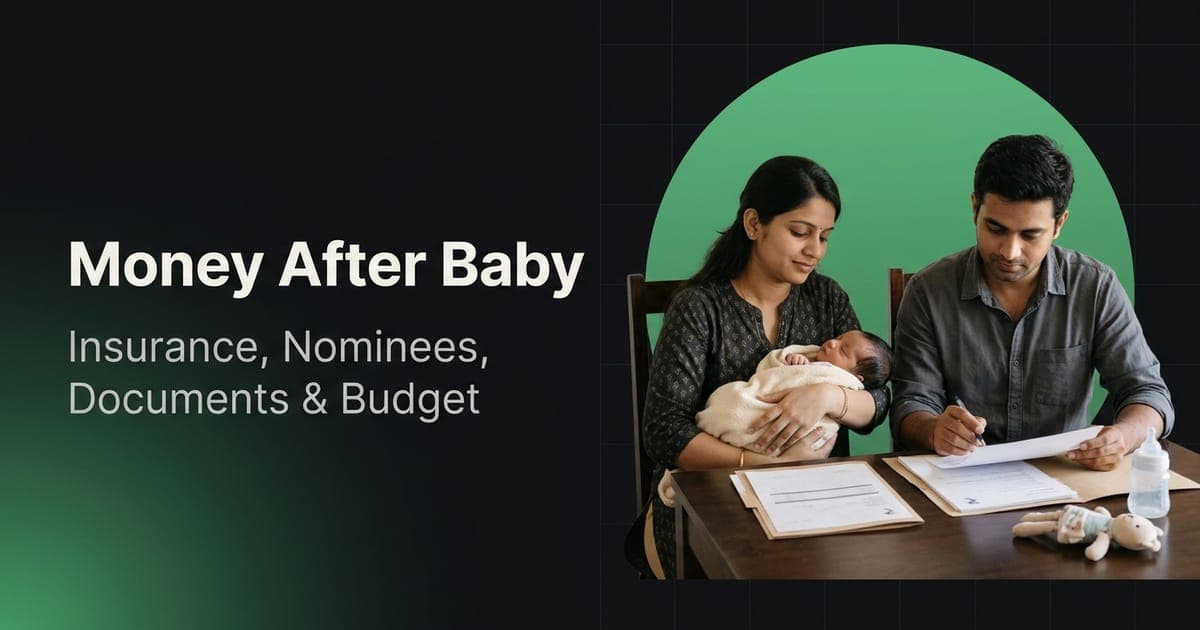
A new baby brings new costs: hospital bills, vaccinations, baby supplies and maybe child care. One parent may also be on leave or working less for a while.
You do not need to sort everything out in the first week. This checklist covers the money and paperwork side of having a baby in India, with a simple plan for the first year.
List new recurring costs and income changes
Start with a realistic picture of what is changing.
New or higher costs:
- Doctor visits and vaccinations
- Diapers, formula and baby supplies
- Child care: help at home, nanny or day care
- Higher household costs, like electricity or a bigger home
- Health insurance premium if you add the baby
Income changes:
- Maternity or paternity leave, and whether it is fully paid
- A parent taking a longer break or switching to part-time
- Any change in support to or from grandparents
Write these down in one place. The first few months often cost more than expected.
Review your emergency savings
With a baby, an emergency fund matters more. There is no fixed amount. A simple way to think about it is: how many months of your new monthly expenses could you cover if income stopped? Recalculate based on your new costs, not the old ones.
Keep emergency money somewhere you can get to quickly. A child's education fund is not an emergency fund.
Organise health and life insurance documents
- Check how and when your newborn can be added to your health policy. Many policies have specific rules and time limits for adding a newborn, so read your policy or call the insurer early.
- Check employer health cover for the same.
- Keep the hospital bills and discharge summary from the delivery, in case you need them for a claim.
- Review life insurance: with a child depending on you, it is a good time to check whether existing cover is enough. Get proper advice for this decision.
- Note policy numbers, renewal dates and helplines in your family records.
Record birth documents and child-related accounts
Your child's first documents will be needed for many things later.
- Birth certificate: register the birth with the local municipal authority. Hospitals often help start this.
- Aadhaar for the child, if you choose to get one.
- Passport, if you plan to travel abroad.
- Make sure names are spelled the same way on every document.
If you open any accounts in your child's name, such as a bank account or PPF, note them in your family records with the guardian details.
Create an education goal record
Higher education is often the biggest goal families save for. You do not need to pick investments right away. Start with a simple record:
| Goal | Child's education |
|---|---|
| Target year | e.g. 2044 |
| Rough cost today | Your estimate |
| Amount set aside so far | |
| Where it is invested | |
| Review date | Every year on birthday |
You can use our goal calculator to see how much you might need to set aside each month. Remember to account for costs rising over time.
Review nominees and emergency contacts
With a child, nominees may change. Go through:
- Bank accounts and FDs
- Mutual funds and demat accounts
- Life insurance
- EPF
You may want to add your child as a nominee. A minor cannot claim on their own, so institutions usually ask you to name a guardian who would act for the child until they turn 18. Our post on reviewing nominees across family accounts has a tracker.
This is also the right time to write a will. A will lets you say who should look after your child and their inheritance if something happens to both parents. A nominee alone does not do this.
Update your emergency contacts so a relative or friend can be reached if both parents are unavailable.
Plan parental leave and cash flow
Before or soon after the birth:
- Find out exactly how much leave you each get and how much of it is paid
- Plan for any months with lower income
- Pause or reduce non-essential spending if needed
- Check whether any SIPs or goals need adjusting for a few months
It is fine to slow down investments for a while. Just make it a decision rather than something that happens because money ran short.
First-year financial admin checklist
| When | What |
|---|---|
| Month 1 | Register the birth and get the birth certificate |
| Month 1 | Add baby to health insurance, within the insurer's time limit |
| Month 1 to 2 | Update the family budget for new costs |
| Month 2 to 3 | Recalculate the emergency fund |
| Month 3 | Review life insurance cover |
| Month 3 to 6 | Get Aadhaar and passport, if needed |
| Month 3 to 6 | Update nominees and name a guardian where needed |
| Month 6 | Write or update your will |
| Month 6 to 12 | Set up an education goal record |
| Month 12 | First birthday review: insurance, goals, nominees |
This is also a good time to set up a family emergency financial file, so your partner or a relative can find everything if needed.
Frequently Asked Questions
How soon should I add my newborn to health insurance?
Check your policy straight away. Many policies have rules and time limits for adding a newborn, and some cover newborns from birth while others need a request within a set period.
Can I make my baby a nominee on my bank account?
Yes, usually with a guardian named to act for the child until they turn 18. Check your bank's process.
Should we start investing for our child's education right away?
Starting early can help, but first make sure your emergency fund and insurance are in place. Then decide on a goal amount and how much you can set aside comfortably.
Do new parents really need a will?
Yes. A will is the main way to say who should care for your child and manage their inheritance if something happens to both parents.
Our free Family Health Check can help you spot gaps in your family's protection and planning. When you are ready, a Kashly family account lets you track goals like your child's education against real investments.
Your family's money,
finally in one place.
See every member's investments together, plan goals as a family, and make sure nothing gets lost when it matters most. Each member approves what they share.
Free 2-minute check · No sign-up needed for the check
Related articles
All Life Events guides →
The Financial Checklist Before Moving Abroad While Your Family Stays in India
Moving abroad while family stays in India? A financial checklist to list Indian accounts, update contacts and residential status, and plan family access.
Read more →
The Financial Checklist After Marriage in India
A practical financial checklist after marriage in India: money talks, documents to update, nominees, insurance, a shared budget and a first-90-days plan.
Read more →
A Family Money Checklist When a Parent Retires
A family checklist for when a parent retires in India: income sources, EPF and gratuity, FDs, insurance, nominees, KYC, monthly cash flow and a yearly update.
Read more →