How to Manage Your Parents' Finances in India: A Practical Guide
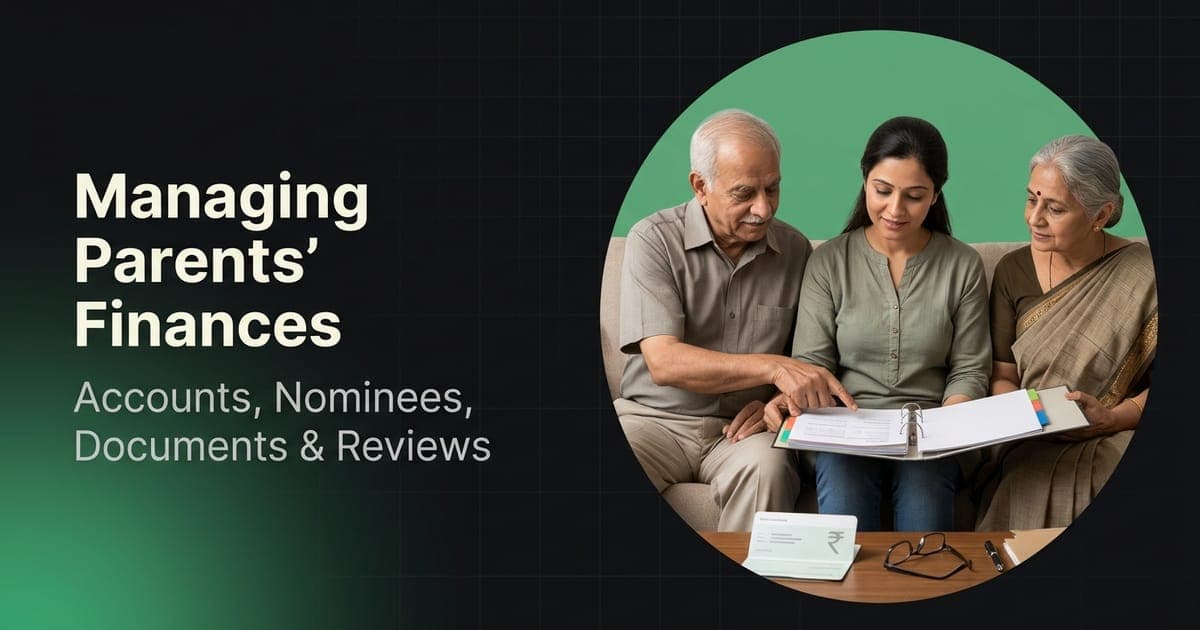
Many of us start helping our parents with money slowly. First it is a KYC update, then an FD renewal, then a question about a bank message. Soon you are handling a lot, but without full information about what your parents have.
This guide gives you a simple process to manage your parents' finances in India. It covers how to talk to them, what to list, what to check, and how to keep the records updated.
Why do family finances get so scattered?
Our parents' generation saved in many small pieces. An FD in one bank because the branch was near the old house. A few mutual funds bought through an agent in the 2000s. An LIC policy from a relative. A PPF account, some gold, maybe a plot in the hometown. Each one came with its own paper, its own passbook and its own login, if it had one at all.
This is normal. It built up over 30 or 40 years. The problem comes when someone else has to understand it, for example during an illness or a hospital stay.
Start with a respectful conversation
The money belongs to your parents. Keep this in mind at every step.
Pick a calm time, not right after a health problem or a bad experience. Make it clear you want to help, not check on them. Something like: "If you ever need me to handle something, I want to know where to look. Can we write it down together?"
A few things that make this talk easier:
- Ask what they want help with. Some parents only want reminders. Others are happy to hand over paperwork.
- Involve both parents, even if one has always handled the money. The other one needs to know too.
- Include your siblings early. Disagreements later usually come from one child knowing more than the others.
- Go slowly. You do not need everything in one sitting.
If your parents are not ready, leave it and come back in a few weeks. Pushing usually does not help.
Create a master list of everything
This is the most important step. One list, kept in one place, that shows what exists. It does not need balances updated every day. It needs to answer "what do they have, and where?"
| Category | What to note |
|---|---|
| Bank accounts | Bank, branch, account type, joint holder if any |
| Fixed deposits | Bank, maturity date, auto-renew or not |
| Mutual funds | Fund house, folio number, held directly or via a platform |
| Shares and bonds | Demat account with which broker or bank |
| Post office and govt schemes | PPF, SCSS, NSC, KVP, MIS |
| Retirement money | EPF, pension, NPS, gratuity details |
| Insurance | Insurer, policy number, type, renewal date |
| Loans and dues | Lender, EMI, end date |
| Property and gold | Location, where papers are kept |
Note the account number's last four digits rather than the full number if you are worried about the list being misplaced. The point is to identify each account, not to copy everything.
If your parents invest in mutual funds, the mutual funds page explains the basics of folios and fund houses in plain terms, which helps when you are reading old statements.
Record nominees, joint holders and KYC status
Once you know what exists, go one level deeper for each item:
- Nominee: Is someone named? Is it still the right person? Many old accounts name a parent who has since passed away.
- Joint holder: Is the account single or joint? "Either or survivor" works very differently from a single account if something happens.
- KYC status: Is KYC complete and current? Mutual fund folios with old or incomplete KYC can get stuck when someone tries to redeem or claim them.
- Contact details: Is the registered mobile number one your parent still uses? An old number means missed alerts and failed OTPs.
Rules around nominees have changed recently. Banks can now take up to four nominees per account, under amendments to banking law that came into force on 1 November 2025. Mutual fund and demat nomination rules were also revised by SEBI in 2025 and again in 2026. Do not assume an account set up years ago reflects what your parents want today.
Set up a secure document index
You do not need to collect every original document. You need to know where each one is.
A simple index works: document name, whose it is, where the original sits (almirah, bank locker, file at home), and whether a scanned copy exists. Keep scanned copies in a secure, password-protected place. DigiLocker is useful for government-issued documents like PAN, Aadhaar and driving licence.
One firm rule: do not write passwords, PINs or OTPs on this list. The index should help someone find an account and follow the bank's proper process. It should not let anyone log in as your parent.
Add an emergency contacts section too: family doctor, a trusted relative nearby, the CA if they have one, and the bank relationship manager if there is one.
Choose a review routine and split the work
A list is only useful if it is kept updated. Agree on a routine:
- Monthly: a 15-minute check on bills, pension credit and anything unusual.
- Every quarter: update FD maturities, insurance renewals and any new investments.
- Once a year: go through nominees, KYC and the whole list properly.
If you have siblings, split the work. One handles insurance renewals. Another tracks FDs. Write down who does what so nothing is missed.
When parents need more help
At some point, a parent may struggle with apps, OTPs or bank visits. A few options exist that keep things above board:
- Many banks offer doorstep banking for senior citizens. Ask the branch.
- Banks also let account holders add a joint holder or give a mandate for operations. Each bank has its own form and conditions.
- If a parent may lose the ability to make decisions, talk to a lawyer about a power of attorney while they can still give consent clearly. Do this early, not in a crisis.
These are legal arrangements with real consequences. Get proper advice for your family's situation.
Common mistakes to avoid
- Taking over without asking. It can hurt trust.
- Collecting passwords "just in case". It is unsafe and often against the bank's terms.
- Building a list and never updating it.
- Ignoring the parent who did not handle money. They may need the information most.
- Assuming a nominee automatically owns the money. In India, a nominee often receives assets on behalf of legal heirs. A will matters too.
A quick checklist to start this week
- Have the first conversation with both parents
- List all bank accounts and FDs
- List mutual funds, shares and govt schemes
- List insurance policies and renewal dates
- Note nominee and joint holder for each item
- Check registered mobile numbers and KYC
- Make a document index (no passwords)
- Set a monthly and yearly review date
- Share the plan with siblings
More guides on managing parents' finances
- Where are my parents' investments? A checklist to find everything
- The financial checklist for ageing parents
- How to organise your parents' financial documents in one place
- How to help elderly parents manage money without taking away their independence
- A family money checklist when a parent retires
- Living abroad? Read how to manage your parents' finances in India from abroad
Frequently Asked Questions
Do I need a legal document to help my parents with their finances?
Not for organising records or reminding them about renewals. You only need formal authority, like a joint account, bank mandate or power of attorney, if you will be carrying out transactions on their behalf.
Should I add myself as a joint holder on my parents' accounts?
It can make day-to-day help easier, but it also changes ownership and access in ways that matter later. Talk it through with your parents and siblings, and read the bank's terms before deciding.
What if my parents don't want to share details?
Respect that and start small. Ask only where documents are kept and who to call in an emergency. Many parents agree to share more once they see the list is for their benefit.
How often should we update the list?
A light check every quarter and a full review once a year works for most families. Also update it after any big change, such as a new investment, a death in the family or a move.
Can I see all my parents' investments in one place?
You can build that view yourself with a spreadsheet, or use a family account where each member approves what they share. On Kashly, parents join by invitation and their investments stay in their own name.
If you want to see how prepared your family is right now, try our free Family Health Check. It takes two minutes, asks only yes or no questions, and shows you where the gaps are. When you are ready to bring everyone's investments into one view, a Kashly family account can help.
Your family's money,
finally in one place.
See every member's investments together, plan goals as a family, and make sure nothing gets lost when it matters most. Each member approves what they share.
Free 2-minute check · No sign-up needed for the check
Related articles
All Parents' Finances guides →
How to Help Elderly Parents Manage Money Without Taking Away Their Independence
How to help elderly parents manage their money while respecting their independence: simple routines, scam safety, who sees what, and conversation starters.
Read more →
How to Organise Your Parents' Financial Documents in One Place
A parents' financial documents checklist with a simple folder system, a document index template and a 30-minute routine to keep everything in one place.
Read more →
The Financial Checklist Every Family Should Complete for Ageing Parents
A complete financial checklist for ageing parents in India: accounts, pension, insurance, loans, nominees, KYC, documents and a yearly review you can follow.
Read more →