How to Organise Your Parents' Financial Documents in One Place
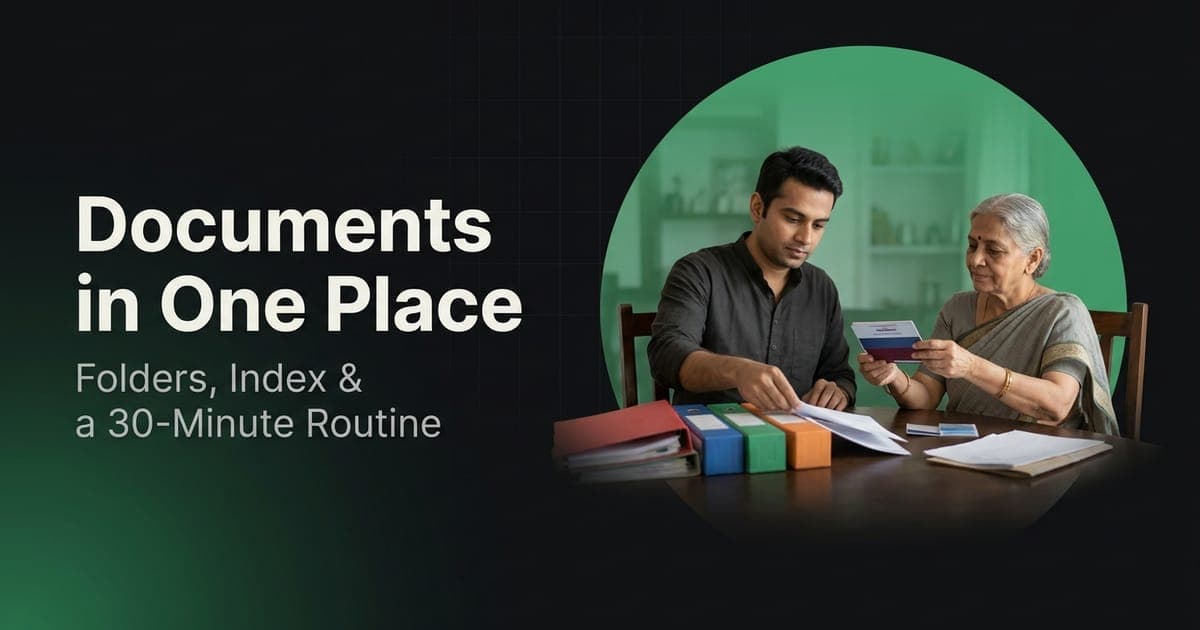
In most homes, financial papers are kept in one cupboard or a few files: old passbooks, policy documents, property papers and statements. Parents usually know where things are, but others in the family may not.
This post shows how to organise these papers into a simple system anyone in the family can use. It covers which documents to collect, how to file them, how to make an index, and how to keep it updated.
Which documents to collect, and why
You are not trying to keep every paper ever received. You want the documents someone would need to manage, claim or transfer an asset.
| Document | Why it matters |
|---|---|
| PAN, Aadhaar, passport, voter ID | Needed for almost every financial process |
| Bank passbooks and cheque books | Show which accounts exist |
| FD receipts | Proof of deposit and maturity date |
| Mutual fund statements or CAS | Show folios and holdings |
| Demat statements | Show shares and bonds |
| Insurance policy documents | Needed for renewals and claims |
| Pension papers and PPO | Needed for pension and family pension |
| PPF, SCSS, NSC passbooks | Post office and govt scheme proof |
| Property deeds and tax receipts | Ownership proof |
| Loan papers | Repayment terms and closure letters |
| Will and power of attorney | Legal instructions |
| Recent ITRs | Show income sources and accounts |
| Medical records | Needed for health claims |
Organise by category, not just by bank
Many people make one folder per bank. This gets confusing because one bank might have a savings account, an FD, a locker and a home loan, all needing different things.
Organise by type instead:
- Identity and personal (PAN, Aadhaar, passport, marriage certificate)
- Banking (all accounts and FDs, any bank)
- Investments (mutual funds, shares, bonds)
- Govt and post office schemes (PPF, SCSS, NSC, KVP)
- Retirement (pension, EPF, NPS)
- Insurance (health, life, others)
- Property and loans
- Legal (will, PoA, nominations)
- Tax (ITRs, Form 16, TDS certificates)
- Medical
Inside each folder, sort by person if both parents have documents in it. Use a different colour tag or divider for each.
Build a document index
An index is a one or two page list that tells anyone what exists and where it is. This is the most useful page in the system.
| Document | Owner | Institution | Last updated | Original kept at | Scan available |
|---|---|---|---|---|---|
| Health policy | Both | Insurer A | Mar 2026 | Folder 6 | Yes |
| FD receipt ..1102 | Mother | Bank B | Jan 2026 | Folder 2 | Yes |
| Sale deed, flat | Father | n/a | 2004 | Bank locker | Yes |
| Will | Father | n/a | 2022 | Lawyer's office | No |
| SCSS passbook | Mother | Post office | Apr 2026 | Folder 4 | No |
Keep a printed copy with the folders and a digital copy in a secure place.
Digital copies versus originals
Scanned copies are great for quick reference and for sharing with a sibling or CA. But for most legal and claim processes, you will need originals or certified copies.
- Keep originals in one safe place: a fireproof box at home or a bank locker for the most important ones like property deeds.
- Keep scans in a password-protected folder or encrypted drive. Name files clearly, like "Mother_FD_BankB_1102.pdf".
- Use DigiLocker for government documents. Documents issued into DigiLocker by the issuing authority are treated as valid in many situations.
Secure access and consent
These are your parents' documents. Agree with them on:
- Who in the family can access the folders and scans
- Where the key or password to the digital folder is kept
- Whether siblings get copies
Usually one or two people having access is enough. More copies means more risk.
Handle sensitive information carefully
Do not keep passwords, PINs or OTPs in the document file or index. Not in the folder, not in the scan folder, not in a notes app. If your parents keep their passwords written down, encourage them to keep that separate and private, or move to a password manager they control.
Also be careful with full account numbers in the index. The last four digits are usually enough to identify an account.
A 30-minute quarterly routine
Set a reminder every three months. Then:
- 5 minutes: Collect any new papers from the past quarter (statements, renewal notices, receipts).
- 10 minutes: File them in the right folders. Throw away duplicates and junk mail.
- 10 minutes: Update the index. Add new items, mark closed ones, change dates.
- 5 minutes: Scan anything new and important.
That is all. Thirty minutes, four times a year.
Once the documents are in order, go through our financial checklist for ageing parents to check nominees, KYC and renewals. If you live away from your parents, our guide on managing parents' finances from abroad has tips for doing this remotely.
Printable index template
Copy this into a notebook or spreadsheet:
| # | Document | Owner | Institution | Ref (last 4) | Original at | Scan (Y/N) | Last checked |
|---|---|---|---|---|---|---|---|
| 1 | |||||||
| 2 | |||||||
| 3 |
Documents are one part of the bigger job. Our practical guide to managing your parents' finances covers the full process, from the first conversation to yearly reviews.
Frequently Asked Questions
Which documents should be kept in a bank locker?
Documents that are hard to replace, such as property deeds, the original will (if not with a lawyer) and physical share or bond certificates. Keep everyday documents at home so they are easy to reach.
Are scanned copies valid for claims?
Usually not on their own. Banks, insurers and fund houses typically ask for originals or attested copies. Scans are still useful for reference and for filling forms.
How long should we keep old bank statements?
There is no single rule for personal records. Many families keep tax-related records for several years in case of income tax queries. Ask your CA what makes sense for your parents.
What if a key document is lost?
Contact the issuing institution. Most can issue a duplicate, though some, like property documents, may need a police complaint and other formalities first.
When your parents' documents are sorted, see what else might need attention with the free Family Health Check. It is quick and you do not need to share any personal details.
Your family's money,
finally in one place.
See every member's investments together, plan goals as a family, and make sure nothing gets lost when it matters most. Each member approves what they share.
Free 2-minute check · No sign-up needed for the check
Related articles
All Parents' Finances guides →
The Financial Checklist Every Family Should Complete for Ageing Parents
A complete financial checklist for ageing parents in India: accounts, pension, insurance, loans, nominees, KYC, documents and a yearly review you can follow.
Read more →
Where Are My Parents' Investments? A Checklist for Finding Everything
Can't find all your parents' FDs, mutual funds or policies? Use this checklist, consolidated statements and official tools to find their investments safely.
Read more →
How to Help Elderly Parents Manage Money Without Taking Away Their Independence
How to help elderly parents manage their money while respecting their independence: simple routines, scam safety, who sees what, and conversation starters.
Read more →