An NRI Child's Checklist for Organising Parents' Financial Records
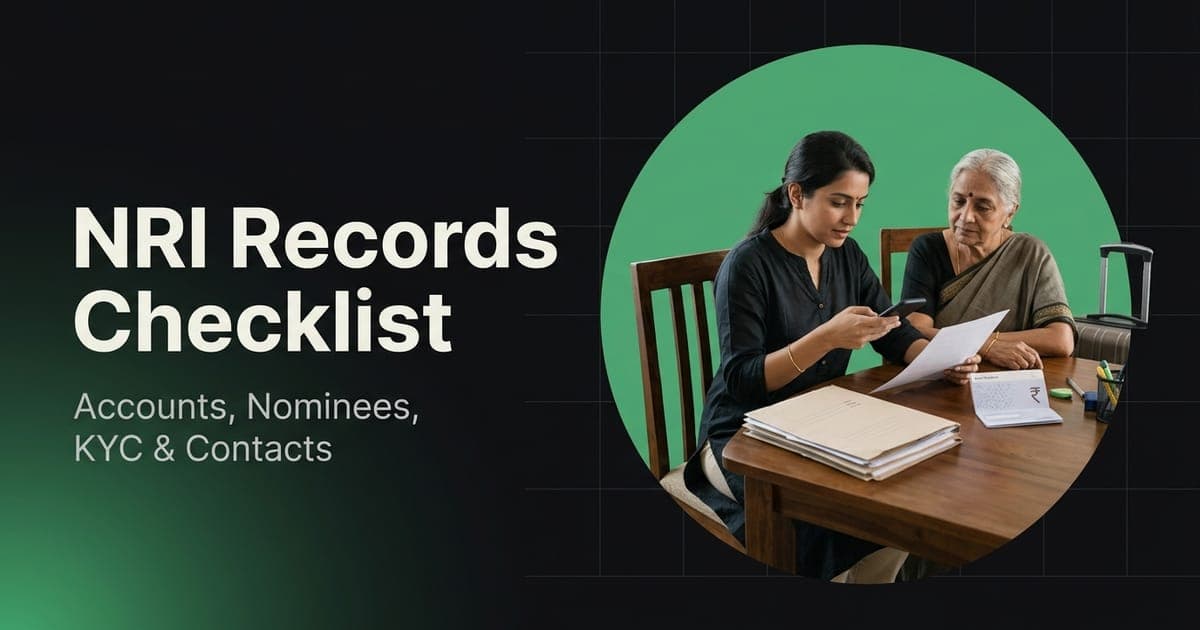
When you live abroad, you get limited time with your parents, maybe a visit once a year and calls on weekends. So it helps to plan how you will use that time for their money matters and paperwork.
This checklist is made for NRI children. It separates what you can do on a video call from what is easier in person, and ends with a simple routine to keep things updated from abroad.
What to gather before you travel or during a video call
Much of the groundwork can happen on a call. Ask your parents to keep their files nearby and go through them together.
On a video call:
- List of all banks they have accounts with
- List of FDs with maturity dates
- Names of fund houses they have invested with
- Insurance policies and renewal dates
- Pension details and when the life certificate is due
- Which documents are at home and which are in a locker
Best done in person:
- Check original documents and their condition
- Visit the bank together for nominee or contact updates
- Open the locker and note what is inside
- Meet their CA or bank relationship manager
- Scan important documents
Plan the in-person tasks ahead. Branch visits often need appointments, and some changes need your parent present.
Accounts, investments, insurance, property and loans
Build one list covering everything:
| Category | Items to note |
|---|---|
| Bank | Bank, branch, account type, single or joint |
| Deposits | FDs, RDs, post office schemes, maturity dates |
| Investments | Mutual funds, shares, bonds, PPF |
| Retirement | Pension, EPF, NPS |
| Insurance | Health, life, any group cover |
| Property | Address, where papers are kept |
| Loans | Lender, EMI, end date |
Our guide on finding your parents' investments explains how to use consolidated statements and official tools to fill gaps.
Institution contacts and document locations
For each bank, insurer and fund house, note:
- Branch address and phone number
- Customer care number
- Relationship manager, if any
- Where the related documents are kept
Write these down on paper for your parents too. A printed sheet near the phone is easier to use in an emergency than a contact list.
Nominees and KYC to verify
These cause the most problems later, so check them carefully.
- Every bank account and FD has the right nominee
- Mutual funds and demat accounts have nominees or a recorded opt-out
- Insurance nominees are current
- KYC is complete for mutual funds and demat
- Mobile numbers and email on accounts are ones your parents use
- Names match across PAN, Aadhaar and accounts
Banks now allow up to four nominees per account, after amendments to banking law took effect on 1 November 2025. SEBI's revised nomination rules for mutual funds and demat accounts apply from 1 September 2026. Ask each institution what options are available today.
If you are being added as a nominee, check that your current overseas address and contact details are on record where possible.
Consent, privacy and access arrangements
Agree with your parents on what you will see and do:
- They are comfortable with you having this list
- Siblings know what is being organised
- Access to scans is limited to agreed family members
- Any operational access uses approved methods (joint holding, mandate or PoA), not shared passwords
Do not collect passwords, PINs or OTPs. Apart from security risks, it encourages a habit fraudsters take advantage of. Our post on managing parents' finances from abroad explains the approved alternatives.
Emergency contacts in India
When you live far away, local contacts are very important.
- A trusted relative or neighbour nearby
- Family doctor and nearest hospital
- Health insurer's cashless claim helpline
- Their CA or tax consultant
- Someone who can accompany them to the bank
Share these contacts with your siblings, and give your parents a printed copy.
A quarterly remote review routine
Every three months, schedule a 30-minute call:
- Upcoming dates: FD maturities, renewals, life certificate, tax deadlines
- New items: anything opened or closed since last time
- Letters and messages: any bank, insurer or tax notices
- Scam check: any odd calls or messages they received
- Update the list and share the new version with siblings
Once a year, add a deeper review of nominees and KYC.
Frequently Asked Questions
What documents should an NRI keep copies of for their parents?
Copies of ID proofs, the list of accounts and investments, insurance policies, pension papers and property documents are the most useful. Keep originals with your parents or in a locker.
Can I complete my parents' KYC updates from abroad?
Your parents usually need to do KYC themselves, either online or at a branch. You can help them prepare and a local relative can accompany them.
Should I be a nominee on my parents' accounts?
That is your parents' choice. If you are named, make sure your contact details are current so the institution can reach you.
How do I keep track of FD maturities from abroad?
Add every FD to a shared list with maturity dates, and set calendar reminders for two weeks before each one.
If you want to see your parents' investments next to your own, a Kashly family account lets them approve sharing with you while everything stays in their name. Our NRI page also explains how our team can speak with your parents directly about paperwork.
Your family's money,
finally in one place.
See every member's investments together, plan goals as a family, and make sure nothing gets lost when it matters most. Each member approves what they share.
Free 2-minute check · No sign-up needed for the check
Related articles
All NRI Family Finance guides →
How to Keep Track of Parents' Investments in India While Living Overseas
How NRIs can track parents' investments in India from abroad: a central list, verified vs estimated values, maturity reminders, time zones and tracker options.
Read more →
How Can NRI Children Help Parents With Investments Without Taking Control?
How NRI children can help parents in India with investments without taking control: information vs decisions, approved access, action logs and talk tips.
Read more →
How to Manage Your Parents' Finances in India From Abroad
Living abroad with parents in India? A practical NRI guide to managing parents' finances remotely: consent, records, check-ins, approved access and local help.
Read more →