How to Keep Track of Parents' Investments in India While Living Overseas
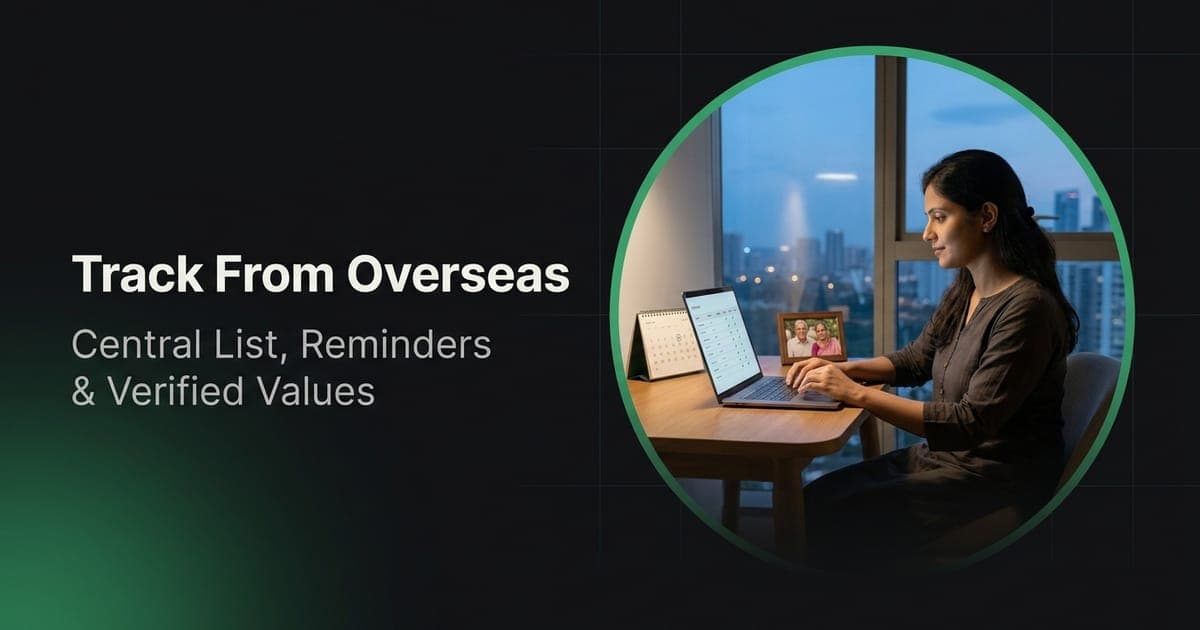
When you live abroad, it is hard to know what is happening with your parents' investments. You may know they have FDs, mutual funds and policies, but not the maturity dates or whether SIPs are still running.
Tracking does not mean controlling. It means having a clear and current picture, so you can remind them, support them and help when needed. This post explains how to set this up from abroad.
Build a central list, with your parents' consent
Everything starts with one list that both you and your parents can rely on. Ask first. Explain that it is so you can help with reminders and be ready in an emergency, not to make decisions for them.
If you have not built the list yet, our checklist for NRI children organising parents' records covers what to gather.
What to track for each asset
For each investment, note:
| Field | Example |
|---|---|
| Owner | Mother |
| Institution | Bank A |
| Type | FD |
| Ref | ..2241 |
| Value | ₹5,00,000 |
| Value date | 1 Sep 2026 |
| Verified or estimate | Verified (statement) |
| Maturity / renewal | 14 Feb 2027 |
| Nominee | You |
| Document location | Blue file, home |
This is enough to be useful without taking too much time.
Use statements and official access, only as authorised
Good sources of information:
- Consolidated Account Statement (CAS): your parents can request one through MF Central, CAMS or KFintech for mutual funds, or get one from NSDL or CDSL if they have demat accounts. They can forward it to you.
- Bank statements: monthly or quarterly, shared by your parents.
- FD advice and renewal letters.
- Insurance premium notices.
- View access through a platform where your parents approve sharing their investments with you.
Do not use your parents' login details to check accounts yourself unless you are formally authorised, for example as a joint holder. Passwords and OTPs should stay with them.
Create reminders for maturities and reviews
The main benefit of tracking is not missing important dates.
- FD maturities: two weeks before, so there is time to decide
- Insurance renewals: a month before, especially health cover
- Life certificate: for pensioners, every year in October or November depending on age and scheme
- Tax filing: if your parents file returns
- Quarterly review: a call to update the list
Put these in a shared calendar that a sibling in India can also see.
Separate estimates from verified balances
It is easy to end up with a list full of numbers you are not sure about. Mark each one clearly:
- Verified: taken from a statement with a date
- Estimate: a rough figure from memory or an old document
When you need to make a decision or explain things to a sibling, you will know which numbers you can rely on.
Handle currency, time zones and communication
- Keep everything in rupees. Converting to dollars or dirhams adds confusion and the number moves with exchange rates.
- Pick a regular call time that suits both time zones, like Sunday morning India time.
- Use one channel for financial updates, like a dedicated WhatsApp group with siblings or a shared document, so nothing gets lost in family chat.
- Ask parents to photograph letters from banks and insurers and send them in that channel.
Spreadsheet or dedicated tracker?
| Spreadsheet | Family investment tracker | |
|---|---|---|
| Cost | Free | Often free |
| Mutual fund values | Updated by hand | Can update automatically |
| FDs, PPF, policies | Easy to add | Varies by app |
| Sharing with siblings | Shared file | In-app sharing |
| Parent's consent | Informal | Built into the approval flow on some apps |
| Effort | More each month | Less, once set up |
Many families use both: an app for market investments, and a simple sheet for FDs, policies and property papers that no app can see. If you are deciding how much involvement is right, our post on helping parents with investments without taking control may help.
For the bigger picture, including safe access, local help and fraud safety, read our guide on managing your parents' finances from abroad.
Frequently Asked Questions
How can I see my parents' mutual funds from abroad?
Ask your parents to forward their CAS, or use a family platform where they approve sharing their investments with you. You should not log in with their credentials.
What is the easiest way to track my parents' FDs?
Add each FD to a list with the bank, amount and maturity date, and set reminders. Most investment apps do not pick up bank FDs automatically.
How often should I update the tracker?
Update values every quarter and check dates monthly. A full review with your parents once a year is a good habit.
Should I convert values into my local currency?
It is simpler to keep everything in rupees, since the money is in India and your parents think in rupees.
With a Kashly family account, your parents can invite you and approve sharing so their investments appear next to yours, while staying in their name. Our NRI page explains more about how we support families across borders.
Your family's money,
finally in one place.
See every member's investments together, plan goals as a family, and make sure nothing gets lost when it matters most. Each member approves what they share.
Free 2-minute check · No sign-up needed for the check
Related articles
All NRI Family Finance guides →
How Can NRI Children Help Parents With Investments Without Taking Control?
How NRI children can help parents in India with investments without taking control: information vs decisions, approved access, action logs and talk tips.
Read more →
An NRI Child's Checklist for Organising Parents' Financial Records
A checklist for NRI children organising parents' financial records in India: what to gather on a call or visit, nominees, KYC, contacts and a routine.
Read more →
How to Manage Your Parents' Finances in India From Abroad
Living abroad with parents in India? A practical NRI guide to managing parents' finances remotely: consent, records, check-ins, approved access and local help.
Read more →