How Can NRI Children Help Parents With Investments Without Taking Control?
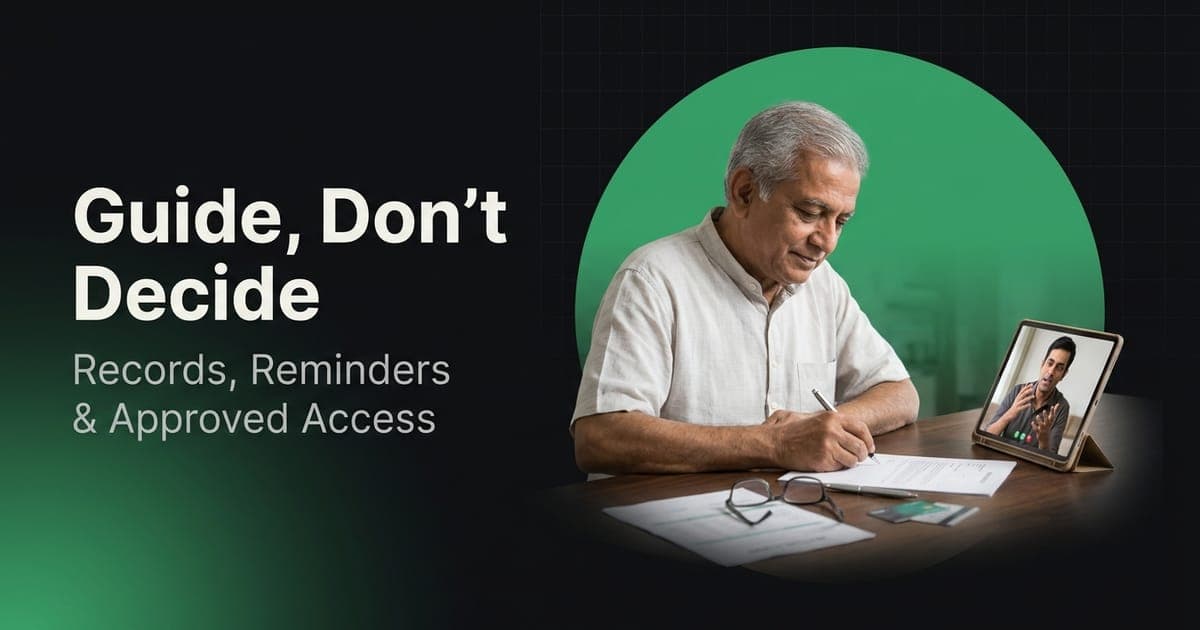
Many NRI children know a lot about investing and want to help their parents in India make better choices.
But when a child says "let me handle your money", parents may feel they are being told they cannot manage it themselves. This post explains how to help in a way that works for both sides, while your parents stay in control of their money.
Separate information support from decision-making
There are two very different kinds of help:
- Information support: organising records, explaining statements, setting reminders, researching options, answering questions.
- Decision-making: choosing what to buy or sell, where to invest a matured FD, whether to break a deposit.
Most parents welcome the first kind. The second kind should stay with them unless they clearly ask you to take it on. Even then, the final say is theirs.
Agreeing on this early avoids misunderstandings.
Ask what help your parents actually want
Do not assume. Ask them.
- Some parents want help only with technology: apps, OTPs, online forms.
- Some want someone to explain options before they decide.
- Some want reminders and nothing else.
- Some are tired of handling it and would like you to take over the admin.
Ask each parent separately too. In many families one parent handled the money and the other would like to understand it better.
Organise records and reminders
This is the most useful help you can give from abroad, and it involves no control at all.
- Build a list of all their accounts, investments and policies
- Set calendar reminders for FD maturities, renewals and the pensioner life certificate
- Keep a simple document index
- Share all of this with siblings
Our checklist for NRI children organising parents' records walks through exactly what to gather.
Use institution-approved processes and consent
If your parents do want you to act on their behalf, do it properly:
- View access: some platforms let parents approve sharing investment details so you can see without being able to transact.
- Joint holding: possible on some accounts, subject to NRI rules on joint accounts with residents. Check with the bank.
- Mandate or power of attorney: banks and fund houses accept these in their own formats. A PoA signed abroad usually needs notarisation or attestation by the Indian mission. Take legal advice first.
These protect both you and your parents. If questions come up later, there is a clear record of who was authorised to do what.
Keep an action log and explain decisions plainly
Any time you help with a transaction or a decision, write it down:
| Date | What was done | Why | Agreed by |
|---|---|---|---|
| 12 Mar | Renewed FD at Bank A for 1 year | Parents prefer FDs for this money | Father, on call |
| 2 Apr | Updated nominee on MF folio | Old nominee had passed away | Mother, signed form |
This takes two minutes and avoids confusion later. It also helps siblings stay in the loop.
When explaining options, use plain words. Avoid jargon and too many charts. "This keeps your money safe but grows slowly. This one can grow more but goes up and down." is often enough.
Avoid informal credential sharing
It is very common for parents to share their net banking password or forward OTPs to a child abroad. It may seem practical, but it is risky.
- It is usually against bank terms
- It teaches parents that sharing OTPs is normal, which fraudsters take advantage of
- It leaves no clear record of who did what
Use the approved options above instead. If your parent is getting OTPs they do not understand, that is a sign to call you, not to forward them.
When local professional help makes sense
Some things are better handled by someone on the ground:
- A CA for your parents' tax filing
- A lawyer for a will or power of attorney
- A bank relationship manager for branch-level tasks
- A trusted relative for accompanying them to appointments
You can coordinate from abroad while local people do the in-person work.
A conversation guide for parents and adult children
Use these as starting points on your next call:
To open the topic: "I'd like to help more with the money side, but only in ways that suit you. What would be most useful?"
To agree on roles: "Would you like me to just remind you about dates, or would you also like me to look at options when an FD matures?"
To talk about access: "If I need to see your investments, can we set it up so you approve it, instead of you sharing passwords?"
To check in later: "Is the way we're doing this still working for you? Anything you'd like me to stop or start doing?"
Our main guide on managing your parents' finances from abroad covers routines, local support and fraud safety in more detail.
Frequently Asked Questions
Can I invest on behalf of my parents in India from abroad?
Only with proper authority, such as a power of attorney accepted by the institution, or if your parents place the transaction themselves. Investing in their name without authority is not appropriate.
Should I move my parents' FDs into mutual funds?
That is their decision, based on their needs, comfort with risk and when they may need the money. You can explain options, but avoid pushing a change they are not comfortable with.
What if my siblings disagree with how I'm helping?
Share the action log and records openly, and agree on roles together. Disagreements usually come from one person knowing more than the others.
How can I see my parents' investments without their passwords?
Use a platform where your parents can approve sharing with you, or ask them to share statements regularly.
A Kashly family account lets parents approve sharing their investments with you, while everything stays in their name and under their control. You can learn more about how we support families across borders on our NRI page.
Your family's money,
finally in one place.
See every member's investments together, plan goals as a family, and make sure nothing gets lost when it matters most. Each member approves what they share.
Free 2-minute check · No sign-up needed for the check
Related articles
All NRI Family Finance guides →
How to Manage Your Parents' Finances in India From Abroad
Living abroad with parents in India? A practical NRI guide to managing parents' finances remotely: consent, records, check-ins, approved access and local help.
Read more →
How to Keep Track of Parents' Investments in India While Living Overseas
How NRIs can track parents' investments in India from abroad: a central list, verified vs estimated values, maturity reminders, time zones and tracker options.
Read more →
An NRI Child's Checklist for Organising Parents' Financial Records
A checklist for NRI children organising parents' financial records in India: what to gather on a call or visit, nominees, KYC, contacts and a routine.
Read more →